So here we are again, with me missing another monthly blog post. But this time, it’s a little bit different than when I missed the post a couple of months ago. This time, something happens to my brain when summer vacation starts, which I’m sure a lot of us can relate to. I suddenly forget what day it is very easily, or at least I hope I am not the only one this happens to!
While I can see how this might not be super productive in many ways, I am missing another post here, but it got me thinking about time. Specifically, how do we mark time and progress? I wonder how important it is to my overall goal of posting a blog post each month that it be exactly each month. What I’m saying is, why did I set this goal? Did I set it to get a certain amount of writing done? Did I set it to have regular posting and content on my website? Both of these things are probably true, so I think I need to be a little bit more graceful when it comes to those posts going up. So I’m gonna post this now at the beginning of June, and I still have another post planned for June that will come later in the month, so I guess it all evens out, right?
How do we mark time and progress? One of the things that I’ve been thinking about while I write my dissertation is how long it takes me to write something. A lot of times, when we write, we discover how hard writing is, which is a bit of a spoiler for June’s post. But thinking about time and goals, why do we mark time in the way that we do? I think this has caused a shift in my thinking in the last few months.
Writing a project like a dissertation, I really think, happens in waves of productivity. Especially in the way that we think about what productivity should be for a product like this. For example, if you work every single day on your dissertation, that does not necessarily mean that every day will include writing, and even if it does, it might even be good writing. I think there’s a period at the beginning of the project when we write what we know, write what is most interesting, and write based on research that we’ve already done. And that makes the number of words on the page relative to the hours we’ve spent working feel really productive. Then we reach this point where we have to go to archives to get more information, read through those documents, and the easy or fun stuff is over. What ends up happening, at least for me, is that I spend a few hours a day reading documents and making notes, and as I’m sure we can all relate to it, it yields maybe a paragraph or two of actual writing on the page. And that can be very discouraging. I started tracking my dissertation’s word count every couple of months. I just noted how many words I had in each chapter. And I made a little graph. It showed me that while chapters were stagnant at times, other chapters were growing. And overall, I am getting words on the page.
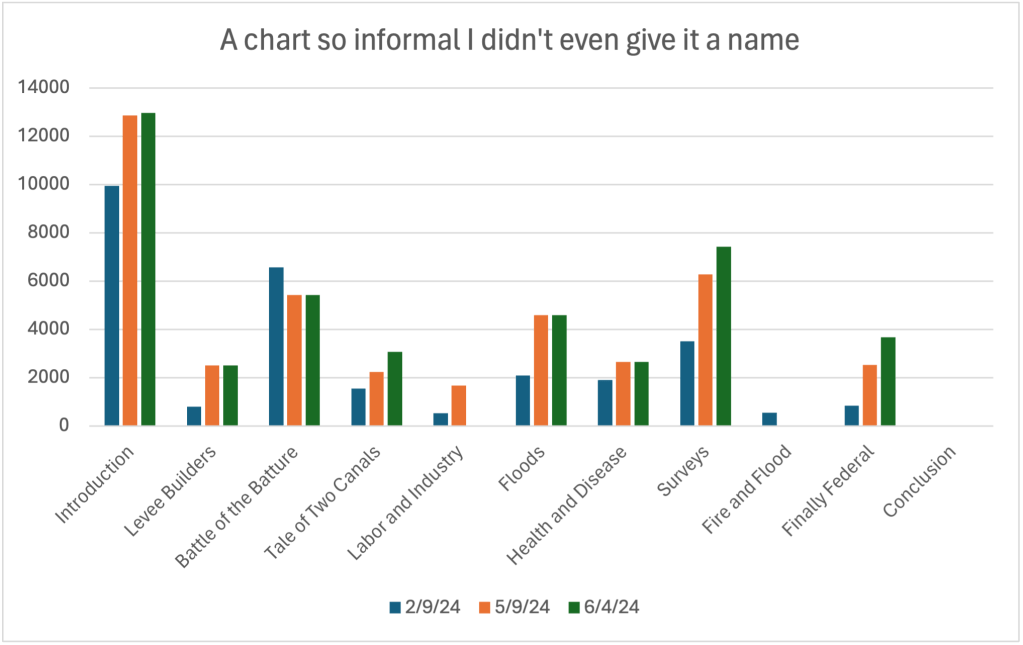
The good news is that I reached the other side of that research/writing slump curve. Now that I’ve done hours and hours of research each day and only written a little, I have a lot of things in my head, so now I’m at a point where the writing is becoming easier. It also doesn’t help that as I creep towards the page goal or the goal or whatever goal it is, I get closer to being done, which obviously makes things feel more attainable. It feels less daunting.
The other thing that really helped me was to stop thinking about chapters, and this is some advice that I got from my advisor. Planning out sections of a chapter or sections of your story is critical, and I used to do this when it came to writing an essay for a class with no problem. I would create an outline, and then eventually, those one-word points on the outline became sentences. Then those sentences would get extended into paragraphs, and then eventually, I would just have a bunch of paragraphs, and I would remove the outline formatting, and boom. I had a pretty decent essay. But I think I stopped doing that when I approached the dissertation because it just felt it was too large of a project to bullet point. But in some ways, I needed to go back to that. It has helped me to break each chapter into sections, even writing each section down on an index card. This has enabled me to see everything I’ve got going on and makes it much easier to move things around as I need to. One of the big things that my advisor and I just discussed is moving away from a thematic approach toward a chronological approach, and that might have felt like a huge undertaking because I have to take chapters that were once thematic and split them up, parsing their information up into other chapters. But thinking in sections means that I can just pick up parts and put where I need them to go somewhere else in the dissertation. It’s basically taking those index cards and rearranging them in a different order. Sure, I’ll have to create new transitions, but it’s not the “time sink” I thought it would be to make these adjustments. And that’s something else important when we think about the time it takes to do something. My goal right now is to just get the words on the page. Sure, some sentences come out very polished, but not everything will, and that’s OK. Part of that is because I’m at the stage where things could change so dramatically and so many things could get cut that I don’t want to waste time, giving specific attention to making my pros perfect for paragraphs that might end up on the chopping block.
All of this is to say that it’s important to think about why we want to track or mark time and see if that is what we are tracking. If I’m tracking total progress towards my dissertation, I’ve made more progress in the last couple of weeks than I have in the last couple of months, despite being in a place where I can’t remember what the day is sometimes or how much work I put in each day, and that’s okay. Well, maybe not the forgetting the day part, but the idea that the feeling of accomplishment and the knowledge that I am making progress in my writing, even if I am not putting words on a page, is important to take a step back and acknowledge because it is incredibly empowering.
 Erica Anne Price